
State-of-the-art TV news technology, circa 1952
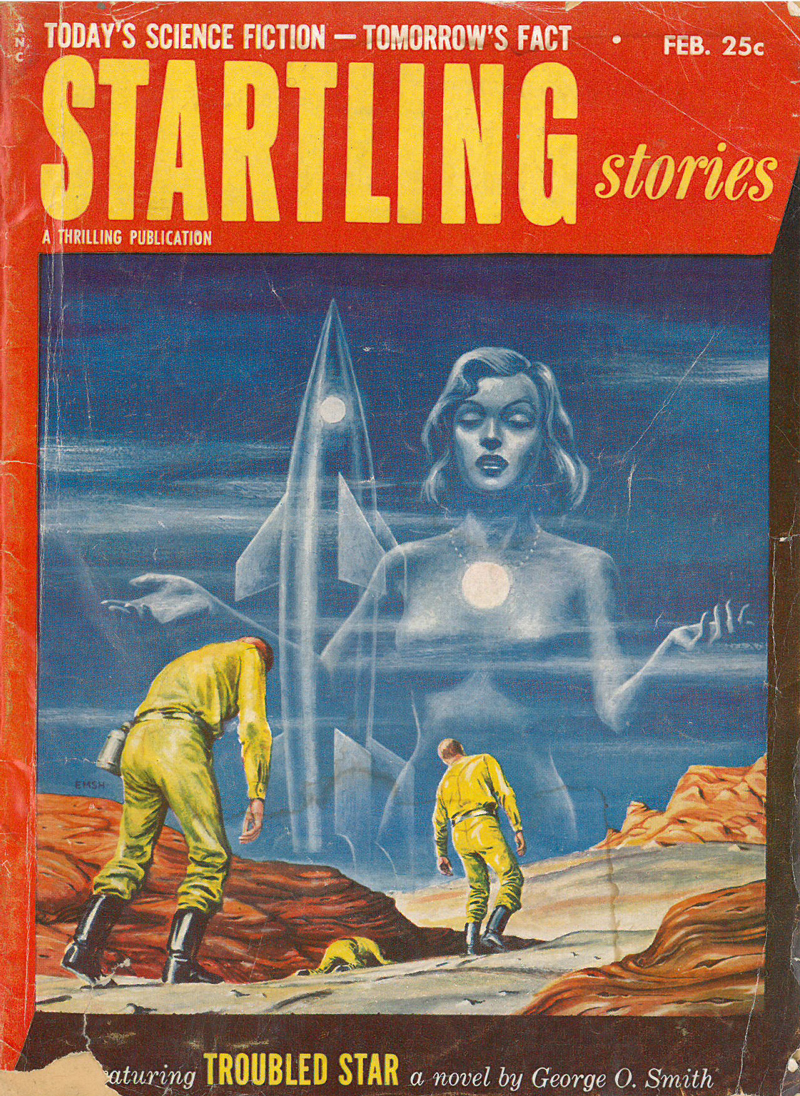
I'm still combing through my grandfather's old SF magazines. Here's a short article which caught my eye about the technology used to broadcast election results in November 1952.
The 1952 presidential contest between Dwight D. Eisenhower and Adlai Stevenson was the first election to see extensive use of TV coverage, with eventual winner Eisenhower famously using short TV ads to enhance his image. But the election was also significant in how the networks used then state-of-the-art technology to both cover the election and predict its outcome as results came in.
The short article below comes from the February 1953 issue of Startling Stories, and reports on how one the biggest challenges in broadcasting TV news of the election was in quickly developing film. It's also amusing that in 1952 the cutting-edge in computers were being built by the National Cash Register Company and the American Totalizer Company.
The article's copy is below. People can also download the article as a PDF scan.
Video-Technics by Pat Jones
On-the-Spot News
WE'RE NOT going in for any political rehashing. The elections are over, and for the most part, the fever has subsided. Some of the improvements in tv techniques which brought the election results quickly and accurately before the public will continue to make news.
To get the story, we talked to NBCs Charles H. Colledge. Newsman and engineer combined, "Joe" Colledge works son the theory that news, like ice cream, "is best when its a scoop."
In getting facts and figures rapidly to the public, two items struck us as being of special interest. One was the way statistics were handled, the other how human interest highlighted the evening.
Special computers were built by the National Cash Register Co. and the American Totalizer Co, each of which had the equivalent of 27 mechanical memories. Thus it was possible to flash up-to-the-minute results of the nations balloting.
The six unique tabulators broke down the results into states and electoral districts, popular and electoral votes, enabling commentators to analyze trends as fast as they developed.
To secure news scoops of human interest from out of the way sources, 16mm movie cameras were often useful. Having the advantage of complete mobility, only one major drawback had prevented their extensive use: the slowness of ordinary film developing processes.
In conjunction with professors from MIT and two NBC cameramen, Colledge conceived and constructed a radically new developing unit for preparing 16mm film.
Unlike other film developers used by networks (some of which occupy an entire room) the hot developer is contained in a box about half the size of a home refrigerator. Weighing 225 pounds, it is portable, and film can be developed en route from its source.
The unit can turn out 1,220 feet of negative film an hour. Only 67 feet pass over its flock of rollers at a given moment, taking roughly two minutes to develop one minutes worth of film. Though spray developers have been built which are faster, commercial immersion developers of this type are larger, and take almost six times as long to develop film.
The trick is the developing formula: it utilizes a 20 second developer, a 15 second shortstop (the bath between the developer and the hypo) and a 55 second fixing agent. Operating at room temperature (6580), a thermometer within the machine rigidly regulates its temperature. Plugged into an ordinary wall socket, it operates with or without running water. Film made this way can be aired in 15 minutes.
Having taken every conceivable feature into consideration, the unit was found to have one flaw: ordinary steel disintegrated in the solution. The roller chains in the experimental model had to be greased carefully to keep it in working order
Future models will eliminate the necessity for elbow grease in getting on-the-spot news Scoops to your tv screens.
On screaming "We're not VD!" while ignoring your relationship with VD

When I first wrote that the Puppy campaigns would sweep the Hugo Awards, I predicted a backlash. So I'm absolutely not surprised that, after said backlash, both Larry Correia and Brad Torgersen are distancing themselves from Vox Day's Rabid Puppies campaign and his threat to destroy the Hugo Awards.
What's interesting about Larry and Brad walking away from Vox Day is that without him it's likely the Puppy campaign would have failed. Nathaniel Givens has done a great job analyzing the Puppy numbers. The Venn Diagram at right is based on Givens' analysis and shows where each of the 20 Hugo finalists in the novel, novella, novelette, and short story categories came from (prior to stories being disqualified or removed by their authors).
As Givens said, "If you want to know where the finalists come from, it looks like Rabid Puppies can’t possibly be ignored. For someone like me who really supported the moderate, inclusive aims of Sad Puppies 3, this is a sobering realization."
Because of the evidence that Rabid Puppies actually won the Hugo nomination process, and because of the anger over what VD has previously said and done, Larry Correia is now saying "I'm not Vox Day." Brad Torgersen is also now insisting that Sad Puppies are not Rabid Puppies.
And for what that's worth, they're speaking the truth. They are not Vox Day.
But what they're not talking about is their relationship with Vox Day.
There's an old strategy at play here, one used to force people to do or give you what you want. Sometimes called good cop/bad cop, it involves one person appearing to be reasonable while the other person makes the threats — even though both people are seeking the same or similar outcomes.
Basically, you let someone else be the heavy. You let that person threaten to destroy everything others love unless you get your way. That way you don't have your fingerprints all over the nasty nasty bad stuff.
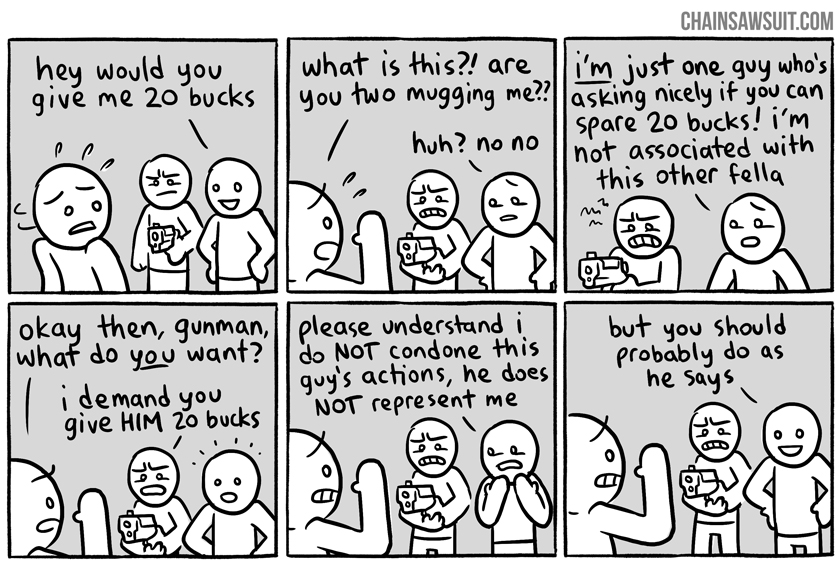
Chainsawsuit by Kris Straub has a great comic summarizing how this strategy works.
I don't need Larry and Brad or anyone else to say they're not Vox Day. I know that. Everyone knows VD is responsible for his own actions and statements.
But what many people suspect is that Larry and Brad worked with VD on all this. And based on the evidence, it's difficult to draw any other conclusion.
For example, Brad ran this year's Sad Puppies campaign and posted their voting slate on February 1. I can't tell you the exact time he posted the slate, but the first comment on the post appeared at 8:40 pm, followed quickly by many more.
Vox Day posted his Rabid Puppies ballot on February 2nd. Again, I don't know the exact time but the comments began coming in a little after 1 am. Depending on the time zone settings of these two sites, that means as little as a few hours separated the posting of the Sad and Rabid Puppies slates.
But hey, let's be generous and say an entire day separated the launch of their "separate" campaigns. If there was no coordination between the two campaigns that means in less than a day VD read all the stories on the Sad Puppies slate, decided which to discard and which to add to his own slate, and launched his campaign.
Oh, and he also found time to contact the artist who created the Sad Puppies logo and have that artist create a similar but different logo for the Rabid Puppies. (The artist is Lee Madison, who uses the name Artracoon on his art. He even set up a site to sell shirts with both Sad and Rabid Puppies logos.)

If it's possible to do all that in such a short time frame without coordinating the two campaigns, I'd love to hear how it was done.
Again, no one believes Larry and Brad are VD. But when people look at all this they see only one campaign, or two campaigns which appear to have worked together.
Until Brad and Larry address this issue, no one will believe that VD didn't work together with them on the Puppy campaigns. And because of that, it's not unreasonable for people to lump both these two campaigns into the same pile of crap.
Note: Post updated to include new Venn Diagram. Thanks to everyone who pointed out the issue with the original diagram.
How's that Puppy thing working out for you?
Today Annie Bellet withdrew her short story “Goodnight Stars” from the Hugo Award ballot and Marko Kloos did the same thing with his novel Lines of Departure.
While Bellet and Kloos were on the slate of stories put forward by the Sad and Rabid Puppies campaigns, both decided that didn't want to be anyone's political ball.
I can totally understand that. Few people like being used by others to score political points.
And this news comes only two days after the novelette “Yes, Virginia, There is a Santa Claus” by John C. Wright was pulled from the ballot for being previously published (and replaced with the novelette “The Day The World Turned Upside Down” by Thomas Olde Heuvelt).
On top of all that, the organizers of Sad Puppies are scrambling (and failing) to disassociate themselves from a certain person who ran the Rabid Puppies campaign.
I will still be reading all the Hugo Award nominees. But if this keeps going I may not have much reading to do.
So Puppies, how's that campaign of yours working out?
A diverse genre contains countless worlds and viewpoints, and I will consider them all
I came to the science fiction and fantasy genre by way of pain and abuse. When I was young and thought the pain would never end, science fiction and fantasy stories kept me going. These stories offered me an escape. They offered me hope. They offered me a glimpse of a world expansive enough to hold a universe of beliefs and outlooks and backgrounds.
I still believe this. Which is why it pains me to see the community which saved my life inflicting such pain on each other.
I'm not naive. There's always going to be pain in the world. But I see no reason why I have to inflict pain on the world in return. And that's why I'm not going to simply dismiss any of the people and works up for this year's Hugo Award, no matter which group helped them make the ballot.
Anyone who follows science fiction and fantasy fandom has likely heard how two similar but separate organized voting campaigns (the Sad Puppies and the Rabid Puppies) worked to overwhelmed the Hugo Award nomination process. Yes, I'm irritated by how these people gamed the Hugo Awards and used the awards to push a political agenda. Despite the protests of the Puppies, this has never before been done on such an organized scale. (For more on all this, I urge people to read Matthew David Surridge's excellent and detailed explanation on why he turned down a nomination for Best Fan Writer. )
Perhaps the best summary on this comes from George R.R. Martin, who points out that there has always been campaigning for the Hugo Awards. But until now, no one group controlled the award.
Now the Puppies do.
But despite my irritation at that, I also realize that if the Hugo Awards weren't broken in the first place none of this would have happened. So some of my irritation is aimed at the people who run the Hugo Awards for not fixing this problem despite many others, including myself, pointing out the flaws in the nomination process.
In truth, I'm no longer angry at Larry Correia and Brad Torgersen for running and promoting this campaign. They played by the Hugo Award nominating rules. They raised a few legitimate issues about the awards (mixed in with a massive amount of simply wrongheaded notions about our genre and the world).
But I'm not writing about that. I'm writing because people are being hurt by all this.
As a result of the campaigning which placed many of the Hugo finalists on the ballot, some people in the genre are attacking every finalist. Some people are also considering voting — without reading the nominated works — a straight No Award across the ballot or in certain categories. Doing so is seen as a way to both protest this political gaming and the motivations behind the campaign.
I understand why people feel this way and would vote No Award without even considering the finalists. But I won't do this. There are many people on the Hugo Award ballot who have not been involved in the Puppy campaign. And whether or not a finalist supported the campaign, not considering their nomination because of politics simply plays into the hands of those who see the Hugos as nothing more than a political weapon.
For example, the story “Goodnight Stars” by Annie Bellet was on the Puppy slate and made the final ballot. Annie has written a moving essay describing her pain at this nomination, even though she did nothing wrong (and her politics definitely don't match up with those of the Puppy campaign originators). I haven't read Annie's story, but I plan to do so.
And I know Annie isn't the only one caught up in this through no fault of their own. Jim Butcher is on the final ballot for Best Novel. For the last week I've heard variations of "Did Butcher know about the Puppy campaign or didn't he?" Well, I for one don't care. I'll read Butcher's novel and judge it on it's own merits. I will not engage in a political litmus test to determine someone's literary worth. I refuse to join the Puppies in in turning the Hugos into nothing more than a political football.
And there are others on the award who should also be considered, such as Best Editor (Short Form) nominee Edmund R. Schubert.
As editor of Intergalactic Medicine Show, Edmund has been extremely supportive of new writers no matter their politics or backgrounds or beliefs. The list of writers who've earned one of their early publishing credits through Edmund reads like a "who's who" of the new generation of SF/F authors, and includes Tony Pi, Saladin Ahmed, Aliette de Bodard, Nancy Fulda, Eric James Stone, Eugie Foster, and many more.
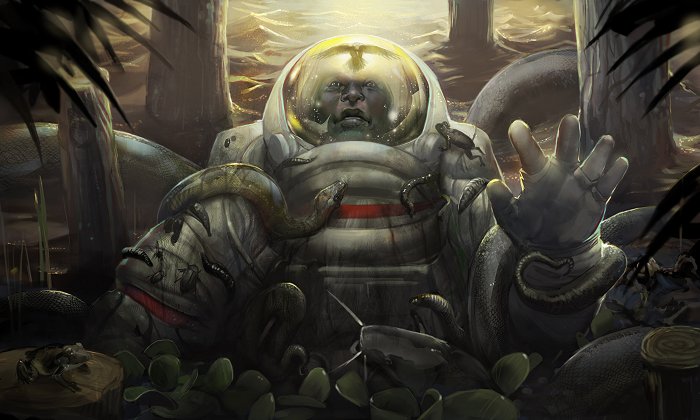
And yes, I'm biased about Edmund because he accepted my first-ever professionally published story. He also published my first short story collection Never Never Stories while working as the editor of Spotlight Publishing. And he commissioned this amazing artwork from fellow Hugo finalist Julie Dillon for my story "The Never Never Wizard of Apalachicola."
But despite IGMS being one of our genre's few professional-level magazines, Edmund has never appeared on the Hugo Award Best Editor ballot. Again, I'm not naive — I know it's because of two reasons. First, Edmund has never been among the trendy insiders in our genre. And it's also likely some people never considered him for the award because the full title of his magazine is Orson Scott Card's Intergalactic Medicine Show. That OSC name trips up people and they hold it against Edmund.
Which is a true shame. After all, OSC doesn't run the editorial side of the magazine. He merely supports the magazine. I am able to separate OSC's political views, which I disagree with, from his support of new writers. This is similar to how most people in our genre support the Writers of the Future contests and programs even though they were founded by L. Ron Hubbard and receive funding from Scientology-related ventures.
Edmund has posted a detailed comment about his nomination on his Facebook page and I urge people to read it. While it shouldn't be a concern with regard to his Hugo nomination, the post may surprise a few people because it reveals that Edmund's politics don't match those of his employer.
As if anyone's politics ever matches anyone else's.
I hope people will join me in saying congratulations to Edmund for becoming a Hugo finalist. He's earned the honor.
I'm also pleased about other nominees on this year's ballot, including Jennifer Brozek, who is a great person and a hard-working editor who has published 14 anthologies over the last five years. I'm also excited that Ms Marvel Volume 1: No Normal by G Willow Wilson made the ballot for Best Graphic Story. Likewise for Wesley Chu, who is up for the Campbell Award. And how can anyone be mad that Guardians of the Galaxy made the ballot because of the Puppies?
I could go on with the name of finalists. But I hope people get my point.
So yes, I intend to consider all of the finalists I've mentioned and more. But I'm also going to consider the people and works I don't already know or don't know well enough. I'll even consider those finalists who supported the Puppy campaign.
Make no mistake: If I judge something or someone to not be worthy of winning the Hugo, I won't vote for them. And if no finalists in a category merit the Hugo Award, I will vote No Award. Because that's what voters do with the Hugo Awards. They judge and vote based on their reactions to the ballot.
As I've said, I'm disgusted by how the Puppy campaign gamed the Hugo Award nomination process. I'm disgusted by the actions and attacks from people who saw the Puppy campaign as an avenue to spread their hate. No, Larry Correia and Brad Torgersen and most of the people who publicly supported or ran the Sad Puppy campaign didn't do it out of hate. They did it because they truly believe the genre is going down the wrong path and they wanted to change it back to some imagined perfection of yesterday.
But that doesn't change the fact that their campaign has hurt a lot of people. And also enabled others to use their campaign for their own purposes.
Based on how Edmund Schubert's editing has been overlooked by the genre, a few of the arguments put forward by Brad and Larry have some merit. I believe Edmund and some of the others on the ballot were never previously nominated both because of politics and because they weren't among the genre insiders and decision makers.
That doesn't mean there was some competing cabal of liberals who made a voting slate and checked their political list and decided who was worthy of making the Hugos and who wasn't. Again, George R. R. Martin describes pretty much what went on before.
But just because I don't agree with the methods or views of Larry and Brad doesn't mean the Hugos didn't need to be shaken up.
Their larger complaints that authors are receiving the Hugos simply because of their race or ethnicity or gender or a straight political litmus test is simply wrong. And their dream of returning the genre to some idealized past which never actually existed is not going to happen. No genre or artform or any human creation survives by going backwards. And even if this was possible, the SF/F genre is growing more diverse and far-reaching by the day.
I want to thank Larry and Brad for demonstrating how screwed up the Hugos are. Perhaps the awards will now finally be fixed. I have a proposal to do just that, as do others. But even if the Hugos aren't fixed our genre will go on. Great stories will still be told. Other awards will honor these stories.
But the genre will not go on if we go around hurting each other. Which is why I hope people will not use this controversy to inflict pain on even more people.
The SF/F genre is beginning to embrace all the worlds and people it should have always been open to. Our genre is now creating new stories and dreams that no one could have imagined even a decade ago. No campaign or voting slate or anything else is going to change that.
I came to our genre because of pain, but I stay because of love. I will state my opinions on what I see around me. I will stand up for what it right. I will try to improve the genre and the world. But I will not use our genre to hurt other people or cause pain simply to further a political goal.
I urge others to do the same.
A modest Hugo Award proposal
I received the following proposal from a long-time genre fan who wishes to stay anonymous. This person cares deeply about the Hugo Awards and, like many people in the science fiction and fantasy field, wants a solution to the current controversy which is threatening to destroy the Hugos once and for all.
After considering all of the alternatives, I think a proposal like this is a solution which could end this destructive fight. Yes, some people involved in Worldcon are already working on rule changes to make it harder to game the Hugo nomination system through block voting. However, it is unlikely anything would be approved until next year's Worldcon because it takes two Worldcon cycles for members to vote and approve significant change to the Hugo nomination process. This means we could easily experience dueling nomination campaigns next year. And the rule changes being considering are, while needed and long overdue, also unlikely to prevent anything like this from happening again. (For a description of the rule changes being considered, see the proposal below.)
But instead of simply tweaking the Hugo rules, perhaps a better solution is to find common ground and agree to fix the Hugo Awards once and for all.
The proposal below seems like something all of fandom could agree to. And even if this proposal doesn't agree with people, perhaps a different form of proportional nominating would work.
I look forward to hearing people's thoughts. And many thanks to the person who sent this proposal to me.
The Proposal
I don't know why I'm writing to you about this, other than that I've seen you post about Hugo nomination rules and potential rumors of changes thereto on Twitter. What I've heard about is a possibility of the "4/6" process, where voters may select 4 titles to nominate, and the nominees list will be at least 6 titles. I actually think this is a step in the wrong direction. (It may — may — help mitigate "sweeps" but an organized campaign can overcome that by simply having 2 (or actually 1.5) "slates" and enough of a push behind them both. But that's not why I don't particularly like it.
Where smaller categories get bogged down and overwhelmed by manipulation — short fiction, related work, etc. — is that there are many dozens of "very good" stories and (since long blog posts are related works now, though another topic would be creating a "short related work" category for that so that book-length related works can have their say, but boy is that a digression) related works, and (with the rise of so many anthologies and small press e-zines that do good work) so many short form editors, etc. That a hundred people like stories ABCDE, and another hundred like AFGHI, and another... so when an aggressive slate pushes VWXYZ everything (except perhaps the "A" that is a majority choice from the get-go) is pushed off. The long tail of good stories is its own defeat.
But! We can solve this with better democracy, in a way that (I hope) even the Sad Puppies would like. The approach is to allow *more* instead of *fewer* nominations per voter, ranked, and counted by a special Condorcet method which preserves proportional representation.
Proportional representation means basically that if 60% of ballots are A-B-C-D-E and 40% of ballots are F-G-H-I-J that the 5 nominees are A-B-C-F-G. This is what I actually favor: minority representation is important no matter which "side" one might be on. It makes for an environment where if 600 people really dig literary spectrum stories, and 400 people really dig pulp adventure, that each can put forth some nominees, instead of the 600 always having their sway. (Or the 400 turning rabid and ramming a wedged slate down everyone else's throat.)
Further, by allowing 10 short fiction nominations, for example, we can avoid the problem of so many people (who like the same 20 stories) splitting their own voice and picking non-intersecting groups of 5 stories, only to be overwhelmed by a dedicated group that won't split its vote.
http://civs.cs.cornell.edu/proportional.html
At that link is a short article about the Condorcet "proportional representation" method, attached to the Cornell server which you can play around with, submitting sample ballot files, etc. (I encourage trying the 60% ABCDE and 40% FGHIJ ballot, because I think it's *awesome* that it comes up with ABCFG.)
Even without the (radical, I admit) step of expanding the nominations to 10 per category per voter, using proportional representation would also prevent a 'sweep' by a true minority bloc. I should note, though, that not expanding to 10 nominations per vote would not allow people to express their preference for more of the long tail of truly fantastic fiction that you and your fellow writers publish each year.