I cut loose my old website host Typepad because of continual service outages. These pages archive all of the blog posts from September 2007 to April 2014.
New story in Bless Your Mechanical Heart
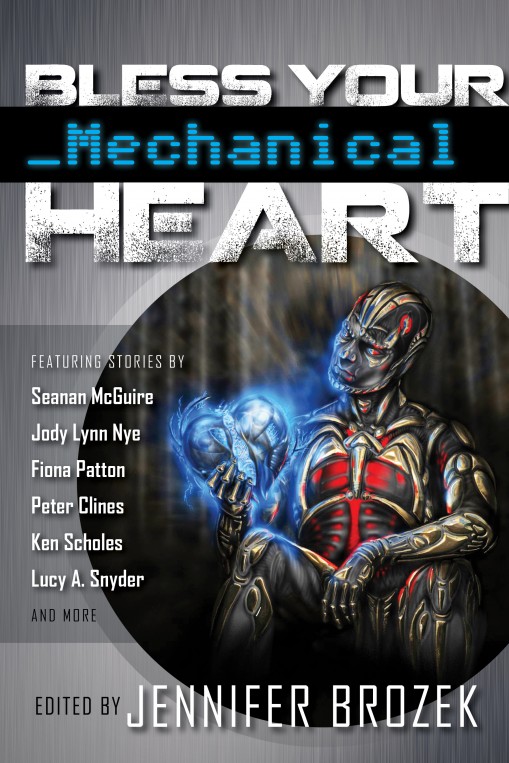
Hungry for a new science fiction story from me? Then I suggest reading "We Eat the Hearts that Come for You," which can be found in the new themed anthology Bless Your Mechanical Heart.
The anthology, edited by Jennifer Brozek, mixes sentient robots and androids with the emotional repercussions of that sarcastic Southern USA phrase "bless your heart." In addition to my story, the anthology also features original fiction by Seanan McGuire, Fiona Patton, Lucy A. Snyder, Sarah Hans, Jody Lynn Nye, Minerva Zimmerman and many more.
I think "We Eat the Hearts that Come for You" is one of the most chilling stories I've ever written, so I hope people will check it out.
You can find the anthology on Amazon and in all the usual booksellers.
The new SFWA Bulletin is blowing my mind
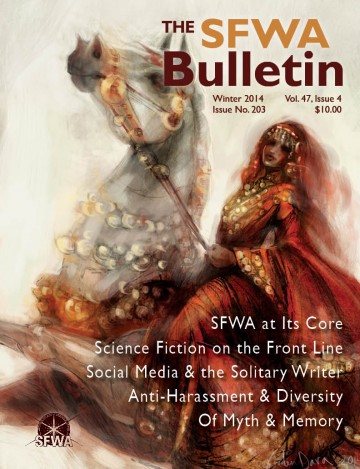
I've been a member of the Science Fiction & Fantasy Writers of America for a handful of years and, as such, have received their Bulletin magazine since joining. My general response to each new issue: Indifference, with occasional sides of irritation and outrage.
Until now I honestly don't think I've spent more than 10 minutes reading any particular issue of the Bulletin. My process upon receiving each print issue has been to:
- Ignore the bad cover art.
- If cover art is sexist, rant about it.
- Flip through the issue and see if there are any articles worth reading.
- Discover that yet again there aren't.
- If articles are sexist, rant about it.
- File the issue in the recycling bin.
The problem with the old SFWA Bulletin—besides continual issues with sexism—was that the Bulletin covered topics which were already obvious to your average SFWA member. That frustrated the hell out of me because one way SFWA should help authors is by sharing knowledge about both our genre and the business of writing.
So imagine my shock when I received the Bulletin's new winter 2014 issue and found tons of articles I actually wanted to read. I mean, check out the following partial list of articles in the new issue:
- Science Fiction on the Front Line by Richard Dansky
- Social Media & the Solitary Writer by Cat Rambo
- Everything Old Is New Again by MCA Hogarth
- Website Redesign & Featured Book by Jeremiah Tolbert
- Anti-Harassment & Diversity by Jaym Gates
- Moving to California: The SFWA Bylaws Overhaul & Reincorporation Process by Russell Davis
- Of Myth & Memory by Sheila Finch
- Picking the Right Convention For You by Nancy Holder & Erin Underwood
- Better Teachers, Better Writers by James Patrick Kelly
- SFWA Reading Series by Merrie Haskell
- Interview: E.C. Myers by Tansy Rayner Roberts
And those are merely the articles I'm currently reading or excited about reading. There are a number of other articles not listed above which I'll eventually check out.
As a bonus, this is also a magazine I can carry in public without being embarressed by the stupidly sexist cover art. Kudos to Galen Dara for the great artwork.
The new issue can be downloaded in PDF and ebook formats from the member-only section of the SFWA website. In addition, print copies are in the mail to members.
Thank you to both SFWA and its members for pushing the Bulletin to be what we always knew the magazine could be. This is what we've all been wanting from SFWA—a member magazine which actually provides useful information to members.
My 2014 Nebula Award nominations
I almost waited too late this year to make my Nebula Award nominations. I could plead that life has been busy—which it has—and that what little free time I have has been consumed by my own writing—which it also has.
But that doesn't change the fact that I waited until the day before the Nebula nominating period closed to post my list of nominations.
Yes, I'm feeling guilty about this. I should have been out there promoting the amazing stories and novels listed below, all of which—in a just world—would make the short list for not only the Nebula Awards but also the Hugos.
Anyway, these are the stories and novels I'm both nominating and recommending. If you're considering your own nominations, take the time to check these out. And if you can't nominate, you should still hunt down these works and read them. They're absolutely worth searching for.
Best Novel of 2013
- A Stranger in Olondria by Sofia Samatar (Small Beer Press)
- Ancillary Justice by Ann Leckie (Orbit)
- Dust Devil on a Quiet Street by Richard Bowes (Lethe Press)
- Love Minus Eighty by Will McIntosh (Orbit)
- The Shining Girls by Lauren Beukes (Mulholland)
Best Novella of 2013
- Freefall by Mercurio D. Rivera (Immersion Press)
- Precious Mental by Robert Reed (Asimov’s)
- Six-Gun Snow White by Catherynne Valente (Subterranean)
- Spin by Nina Allan (TTA Press)
- Yseul's Lexicon by Yoon Ha Lee (Prime Books, Conservation of Shadows)
Best Novelette of 2013
- A Hollow Play by Amal El-Mohtar (Glitter & Mayhem, Apex Book Co.)
- Pearl Rehabilitative Colony For Ungrateful Daughters by Henry Lien (Asimov's)
- The Litigation Master and the Monkey King by Ken Liu (Lightspeed)
- The Waiting Stars by Aliette de Bodard (Candlemark and Gleam)
- They Shall Salt the Earth with Seeds of Glass by Alaya Dawn Johnson (Asimov's)
Best Short Story of 2013
- Effigy Nights by Yoon Ha Lee (Clarkesworld)
- Karina Who Kissed Spacetime by Indrapramit Das (Apex)
- Samsa in Love by Haruki Murakami (The New Yorker)
- Selkie Stories are for losers by Sofia Samatar (Strange Horizons)
- The Sounds of Old Earth by Matthew Kressel (Lightspeed)
2013 Bradbury
- Gravity by Alfonso Cuaron
- HER by Spike Jonze
- Hunger Games: Catching Fire by Francis Lawrence
- Pacific Rim by Guillermo del Toro
- The Day of the Doctor by Stephen Moffatt
2013 Norton (Best Young Adult Novels)
- Sister Mine by Nalo Hopkinson (Grand Central)
- The Summer Prince by Alaya Dawn Johnson (Arthur A. Levine Books)
In praise of virtual connections
My new essay "In praise of virtual connections" is now live on my Sci-Fi Strange Medium.com collection. In the essay I discuss why our interconnected world isn’t the cause of social disengagement, and might even fix it. For good measure I even throw in Sturgeon’s Law and apply it to human communications and lives.
If you like the essay, consider following my Sci-Fi Strange collection, which is updated regularly with works by myself and many others.
Ed Kramer: Science fiction and fantasy's Woody Allen
Yesterday the New York Times published a heart-rending and eloquent letter from Dylan Farrow describing the sexual abuse inflicted upon her by her adoptive father Woody Allen. Words can't describe the anger I feel at both Allen for doing this and at Hollywood for enabling him and looking the other way.
Roxane Gay gets to the heart of the matter in her must-read essay "Compartmentalizing Woody Allen," about how both America and Hollywood see what they want to see. But I also think it's much more than that, something Dylan Farrow alluded to in her letter when she calls out actors like Cate Blanchett, Louis CK, Alec Baldwin and Diane Keaton for looking the other way.
Basically, as Upton Sinclair once said, "It is difficult to get a man to understand something, when his salary depends upon his not understanding it!" Add prestige and fame to that quote and you're close to understanding why Hollywood wants so desperately to ignore the truth about Woody Allen.
But it's easy to act like we're so much better than those Hollywood big shots, who refuse to see the truth screaming in their face. But some of those in the SF/F field haven't acted much better with our own Woody Allen, the infamous Edward E. Kramer.
For those who don't know, Kramer is a well-known editor and writer who was also a co-founder and former part-owner of Dragon*Con. In 2000 he was charged with molesting three teenage boys in incidents stretching back to 1996. However, instead of going to trial, Kramer fought to postpone any day of justice, saying severe health concerns made him unable to attend his trial. This dragged on for more than a decade until, in 2011, the too-ill-for-trial Kramer was—surprise—caught hiking in Conneticut and staying in an hotel room with an underage boy.
Kramer's long evasion of justice for his victims ended in December 2013 when he pleaded guilty to three counts of child molestation. However, since then I've yet to hear any words of apology from Kramer's many defenders in the SF/F genre.
You see, during all this a number of notable SF/F authors voiced their support for Kramer. Now obviously these defenders didn't enable or help Kramer commit his crimes. That was totally on Kramer. But by coming to Kramer's defense they enabled him to claim the role of victim in all this. That helped him draw out his trial for more than a decade, which delayed justice from being served.
To the credit of SF/F fandom, people eventually threatened to boycott Dragon*Con unless they severed ties with Kramer, which they did. But I've heard no apologies from any of Kramer's other extremely vocal defenders in the genre.
Just like Hollywood, many in the SF/F community are too willing to look away from sexual abuse and child molestation when it is inconvenient to either themselves or the genre. However, doing this actually weakens the genre and harms all of us, as it encourages a culture of silence and allows predators like Kramer to continue harming new victims.
When yesterday became the forever template of the future
Something broke for me the other day. I was reading the latest explosion of anger and hate against a science fiction author for doing what SF authors are supposed to do and I realized that the genre I love and write in—the science fiction dreams which expanded and shaped how I see the world—are dying.
In this case, said explosion came at Alex Dally MacFarlane for writing about desiring "an end to the default of binary gender in science fiction stories." Specifically, MacFarlane writes:
"Post-binary gender in SF is the acknowledgement that gender is more complex than the Western cultural norm of two genders (female and male): that there are more genders than two, that gender can be fluid, that gender exists in many forms."
MacFarlane is correct, and I urge people to read the essay. And if you want to know what MacFarlane is speaking about, read the novel Ancillary Justice by Ann Leckie, which deserves to make all of this year's major SF award short lists. Ancillary Justice is an amazing story and a mind-bending read, especially with regards to how the novel deals with gender issues.
The novel isn't the be-all and end-all on gender complexity—hell, what could be?—but it shows so clearly what an author can accomplish when we move beyond our staid ideas of what the present and future must be. When we actually realize that the universe isn't modeled after any one of us, and that the diversity of our existence is the diversity of us all.
And that's my problem with the attacks on MacFarlane's essay. That's why something has finally broken within me with regards to the science fiction genre.
The science fiction of today suffers from an extreme case of nostalgia, a nearly fatal case, to be quite blunt. Nostalgia for a white-bread 1950's Golden Age of SF which never really existed quite as everyone longing for it believes. Nostalgia for a future which doesn't even look like our diverse present-day times, let alone how the future might actually turn out to be.
Instead of celebrating new outlooks and ideas, today's SF regurgitates spaceship-filled Happy Meals complete with a side of forgetful fries—forgetting that the Golden Age of SF wasn't golden for so many people. Forgetting that science fiction without true speculation and insight into life is a dead, dead thing.
I'm tired as hell of all this. And I'm not the only one. Jonathan McCalmont has written on this very topic in Interzone.
I understand that many people don't like change and want to stay snuggled in their warm dreams of a past which never happened. But if you're reading science fiction, you must on some level be interested in expanding your horizons. On some level you must want to see beyond your own limitations. You must want the future to be more than a forever template of the past.
At least, I used to think this about science fiction. I'm no longer so sure it's true.
Recent Sci-Fi Strange essays on Medium.com
Wondering why I haven't posted many items on my blog? That's because I'm running a great Medium.com collection called Sci-Fi Strange. The collection is updated regularly with SF and pop-culture influenced articles by myself and others.
Recent essays I've posted include:
- Do realistic special effects spoil our sense of awe?
- We’ll have good SF films when the geeks finally rule—or destroy—Hollywood
- Science fiction doesn’t predict the future, it creates the future
- The law of diminishing returns on special effects
If you like what you're seeing, please go and follow the collection.
Free copies of my story "Monday's Monk" from Asimov's Science Fiction
Nominations are now being accepted for the Nebula Awards and will open shortly for the Hugos. Because I've been focusing on finishing a novel, I have only two stories eligible for award consideration this year. They are:
Monday's Monk
My 8,700 word novelette "Monday's Monk" was published in the March 2013 edition of Asimov's Science Fiction. The story was inspired by my experiences while serving with the U.S. Peace Corps in Thailand, where I had the opportunity to study and work with monks from several Buddhist monasteries, including Wat Pah Nanachat.
The novelette has been well received, with Locus Magazine's Lois Tilton both recommending it and naming this "harrowing account of an individual’s struggle to retain his integrity and religious principles under a genocidal regime" to her year's best list. (Update: Locus Magazine added the story to their 2013 Recommended Reading List, as did Tangent Online , which gave it a top possible score of 3 stars.)
Other reviews include John Sulyok in Tangent Online, who calls the story a "must read," and Sam Tomaino in SFRevu, who says "Monday's Monk" is a "great story."
- To read "Monday's Monk," you can download the story as either a MS Word document, a Rich Text document, a PDF, or as an ePub file.
Paprika
My other story for consideration is my 7,900 word novelette "Paprika," which was published in issue 249 of the British magazine Interzone (Nov./Dec. 2013). As I mentioned in the author's note to the story, "Paprika" was inspired by the life of acclaimed anime director Satoshi Kon, who passed away in 2010 at the age of 46.
Over on Wizzley, my story is called "beautiful ... and a fitting tribute to anime director Satoshi Kon" while Matthew Dent says the story gets the "imagination firing on all neurones."
Because the story is in the current issue of Interzone, I am unable to post it online. If you don't have access to the issue and are a voter for the any of the major genre awards, contact me.
My Sci-Fi Strange pop culture and science fiction collection on Medium.com
Let's be blunt—all pop culture these days is pure science fiction. Between Twitter and iPhones and instant message videos of your grandpa's twerking, today's pop culture takes place on and around platforms which only a decade ago would have been pure science fiction.
I've long been fascinated by the intersection of science fiction ideas and pop culture. To explore this I've started a Medium.com collection called Sci-Fi Strange. The collection will be updated daily with SF and pop-culture influenced articles by myself and others.
If you're not familiar with Medium, check out this post. Slate's Matthew Yglesias also offers a great overview of the social media platform, calling it the "best writing tool around."
In addition to Medium being a great writing tool, I also think it's a damn good reading tool. If you have a Medium account, consider following my Sci-Fi Strange collection. I'll still be posting on this website, but depending on how the Sci-Fi Strange collection goes I'll probably be more active there.
The law of diminishing returns on special effects
Yesterday my family witnessed the marketing event that is The Hobbit: The Desolation of Smaug, a film so overwrought with special effects that its director, Peter Jackson, was able to magically transform a single novel into nearly 9 hours of media tie-ins.
My family was looking forward to the film because, for the most part, we'd enjoyed The Hobbit: An Unexpected Journey. Yes, the first Hobbit film was overlong and slow at times, but it was still a decent visual escape.
But that said, there was one scene in the first movie which bored me to cliched tears. This happened when Bilbo's companions were fleeing from the goblins, killing one after another in swordplay and violence which felt more cartoony than true special effects. During this one extremely long scene I kept waiting for the mind-numbing crush of special effects to pass so we could return to the film's actual story.
So imagine my irritation when I discovered that this FX bordom was not only repeated in The Desolation of Smaug, it happened in even more scenes.
Specifically, I was bored out of my mind by two scenes in The Desolation of Smaug—the scene where Bilbo and his companions escape in barrels down the river while fighting orcs, and the one where they fight against Smaug in the ruins of the Lonely Mountain. In fact, this last scene gives moviegoers one of the most boringly majestic special effects I've witnessed in years (spoiler alert) when the dwarves reactivate the forges and create a Statue of Liberty size golden statue, which immediately bursts apart in rivers of gold.
Instead of excitement and awe at this FX spectacle, I checked my phone to see how much longer the film would run.
Now don't misunderstand me—I love science fiction and fantasy special effects, which can show us worlds and visions we'll never experience in this lovely little thing we call reality. And there are some amazingly effective special effects in The Desolation of Smaug, such as when the dragon first appears and plays with Bilbo as he stumbles over countless mounds of treasure. But these effects are effective when they tie in with and support the film's larger drama. When Bilbo is face to face with a dragon, knowing that his words—and the dragon's attempt to learn more about him—are all that keep him alive. In such scenes, wow, the special effects work exactly as they should.
But special effects quickly grow extremely boring when they are supported by neither drama nor tension nor storytelling.
Part of the problem is that special effects have become so relatively cheap and easy to create that they are being used to fill storytelling holes in films. But when special effects are used in this manner they actually undercut what they're meant to accomplish.
To explain how this happens, I'd like to propose a law of diminishing FX returns: Every time a special effect becomes 50% easier to create, it becomes twice as hard to impress the audience.
This means the first time a specific special effect is shown to audiences, they will be amazed. However, from then on that particular special effect is the new normal, meaning a film which employs it will have to work twice as hard, or use the effect twice as much, to dazzle audiences. But the trap is that once you use the effect twice as much in a film, that becomes the even newer norm, meaning the next time the effect is used it must again be presented twice as much to create the same sense of awe.
At that doubling rate of diminishing returns, a particular special effect quickly becomes nothing but boring background and a waste of the audience's time.
So what does this mean for the future of filmmaking? If Hollywood remembers that special effects are meant to support storytelling and drama, then they'll have no problem. But if directors and producers believe that special effects can be used to cover-up and obscure a weak story, then they'll soon discover that they have to keep shovelling in massively more and more FX BS to dazzle an audience. And that's a special effects arms race Hollywood is destined to eventually lose.
Million Writers Award update
Since I'm receiving so many emails on the Million Writers Award, I wanted to post a statement: The top ten stories and the public vote are coming! Soon! The top ten stories have been posted and voting is now open.
As I've said before, we have new administrators running the award this year and there's been some teething pains. But the top ten stories have been selected and should be released shortly—as in within days (I hope)—and the public vote will start at that time.
A big part of the delay was on me. Even though I passed the award duties to others because I no longer had time to manage the award, I still volunteered to be one of the final three judges. I probably should have realized that lack of time + still volunteering would result in me being the tardiest of the judges in turning in my selections.
So stay tuned. The Million Writers Award is coming here.
Art for my upcoming Interzone novelette "Paprika"
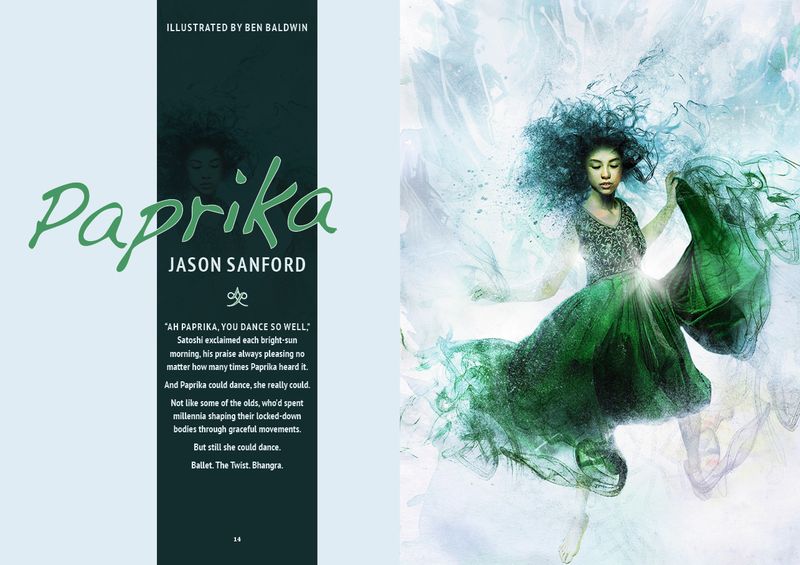
My 13th story in the Britsh magazine Interzone will be published in their upcoming Nov./Dec. 2013 issue (number 249). The SF novelette, titled "Paprika," is set in the far future and involves an artificial construct designed to preserve copies of human lives.
Interzone editor Andy Cox sent me the art for the story and yet again I'm blown away by what they've created. Interzone has no equal for the honor of world's most beautiful SF/F magazine. The art is by Ben Baldwin, who has also created other artwork for my Interzone stories.
As always, if you want to read the story I suggest you subscribe. Individual issues will also be available in stores beginning in December (for American readers, you'll likely have to wait until January to find copies in stores).
It's not easy being (Judge) Green
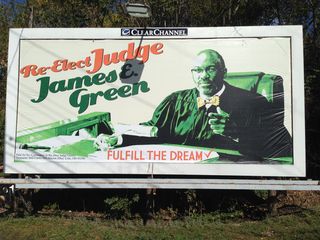
This political billboard ad, which I pass daily going to work, has to be one of the worst ever. I mean, can you imagine the stoned photoshop wiz who convinced Judge Green to go with this ad. "Oh wow, dude, your last name's Green. We should totally make you, like, green!"
Every time I see this billboard I want to start singing "It's not easy being green" alongside Kermit the Frog.
The sad thing is that Judge Green's a highly respected and effective judge here in Ohio. I sometimes think this ad might be so bad it's actually genius because it forces people to remember his name. Since judicial elections have problems with voters remembering candidate names, that wouldn't be a bad thing.
But then I snap back to reality and realize, no, this ad does Judge Green absolutely no favors.
Why do SF fans love to destroy science fiction?
By now most science fiction fans have seen Alfonso Cuarón's film Gravity, or at least heard of it. They've likely also witnessed the building backlash against the film. First came astrophysicist Neil deGrasse Tyson, who detailed a long list of scientific issues with the film. Then former astronaut Scott Parazynski did the same. I've also heard similar complaints from other science fiction fans, complaints that the most scientifically accurate SF film in years isn't accurate enough.
As a science fiction lover and writer, I'm not going to quibble over all the nitpicks about Gravity. Yes, I realize that space stations and satellites orbit at different heights. And yes, I realize that Sandra Bullock’s hair does not float freely on her head at all times like it would in free fall.
But you know what: WHO GIVE A DANG! I still enjoyed the movie and think it's wonderful that people are watching a SF film which is as close to scientifically accurate as anything Hollywood is likely to create.
Understand this—fiction is NEVER real life. The very nature of stories dictate that they can never be totally accurate. And this obsessive harping on trivial issues while missing the larger picture is one reason science fiction—true science fiction, as opposed to science fantasy like Star Wars or Star Trek—is ignored by most people.
I mean, the only reason I see for all this nitpicking is so a few scientists and SF insiders can show how only they truly understand science fiction, as opposed to all those unwashed heathenistic fans who dared to watched an actual hard SF film. What these people appear to be saying is that only nitpicking asshats deserve to decide what passes some BS "science fiction" test.
Well, as a science fiction lover I'm sick of this attitude. Our genre is bigger than the nitpickers among us. Our genre is bigger than those who would so shrink our science fiction stories that they only appeal to a few insiders.
Making a compelling story which is also a hard SF movie is just that, hard. So I for one applaud the realism in Gravity, even as I understand that some of the film's scientific accuracy was shortchanged in the interest of keeping the story going.
And for those who desire to nitpick the film to death, know this: For a genre which is supposely about such big issues, science fiction needs to stop dwelling on the minutia of fail. Otherwise our genre will so exclude itself from being enjoyed by anyone that nitpicking will soon be all science fiction has left to offer.
Sending love and support to Eugie Foster
One of the great things about the genre community is how many amazing people you have the opportunity to interact with. And one of the best people in our genre is Eugie Foster.
I first began working with Eugie when she edited The Fix, TTA Press' tragically short-lived short fiction review magazine. Eugie was a delight to work with, as anyone who has likewise worked with her on DragonCon can easily attest. But in addition to being a great person she's also an amazing writer, having won the Nebula Award for Best Novelette for her mind-blowing story "Sinner, Baker, Fabulist, Priest; Red Mask, Black Mask, Gentleman, Beast." This is one of the best stories I've read in the last decade (you can read my thoughts on the story here).
Sadly, Eugie has been diagnosed with cancer and will shortly begin treatment. While she has health insurance, she is still facing significant financial hardships. Please pop over to her site and see what you can do to help. As Eugie mentions, one of the best ways to help—and the best way to easily read her stories—is to purchase an e-book edition.
Good luck during all this, Eugie. And know that your friends in the genre community will be by your side in the coming months and years.
The passing of James A. Emanuel, the best poet you've never read
Last Saturday the best poet you've never read, and possibly never heard of, passed away.
James A. Emanuel died in Paris on Sept. 28 at age 92, but there's been no coverage of his passing in the English-language press (aside from an essay by poet Dan Schneider, who has long been a fan of Emanuel's writing). This is a shame but, considering how Emanuel has long been overlooked by the literati of this world, not a surprise.
It's impossible—or perhaps only unjustly difficult—to sum up Emanuel's life in a few words. Still, for those unfamiliar with him here is my attempt: Born in Nebraska in 1921, Emanuel attended Howard University and served as personal assistant to famed general Benjamin O. Davis, Sr. during World War II. He published hundreds of poems, many of which are collected in Whole Grain: Collected Poems, 1958–1989 (you can also find a number of his poems online). Emanuel also edited the influential 1968 anthology Dark Symphony: Negro Literature in America, which was one of the first major collections of African American writings. During the last few decades Emanuel lived in Paris, where he continued to write and was an active member of that city's African-America expatriate community.
Of course, those few sentences don't even begin to do justice to his life. If you'd like to learn more about him, I suggest you download this PDF of his obituary. While most of the obit in in French, several of his poems are printed in English.
Jean Migrenne, who has translated some of my stories into French, worked closely with Emanual over the last few decades. According to him, Emanuel's funeral was attended by a small gathering of 23 people, about one third French and the rest members of the African-American community in Paris. His two widows were also there. He was buried in a simple pinewood coffin, with each of his widows placing a red rose on it in turn.
As Migrenne told me, a dozen news photographers were present in the cemetery during the service, but they were there for someone else's funeral, a famous journalist who often wrote about media and rock and roll stars.
I think it's safe to say only one of these writers will be remembered a hundred years from now, and that writer will be the quiet poet now resting in a pinewood coffin.
Here's one of this poems, which seems like the perfect way to honor the memory of this great poet.
Sonnet For A Writer
Far rather would I search my chaff for grain
And cease at last with hunger in my soul,
Than suck the polished wheat another brain
Refurbished till it shone, by art's control.
To stray across my own mind's half-hewn stone
And chisel in the dark, in hopes to cast
A fragment of our common self, my own,
Excels the mimicry of sages past.
Go forth, my soul, in painful, lonely flight,
Even if no higher than the earthbound tree,
And feel suffusion with more glorious light,
Nor envy eagles their proud brilliancy.
Far better to create one living line
Than learn a hundred sunk in fame's recline.
storySouth Million Writers Award notable stories of 2012
Listed below are the storySouth Million Writers Award notable stories of 2012. Congratulations to all of the named authors. The list will be uploaded to the storySouth website soon, along with the names of the preliminary judges who selected the stories. Many thanks to these judges and to all the readers and editors who nominated stories.
The three final judges—and in the interests of full disclosure I'm one of the them—are currently reading through the stories and picking the top ten. Those stories will be released early in October.
In other news, thanks to the great donors who stepped up this year the Million Writers Award will be offering more than $1000 in cash and prizes to the top stories.
And in a final round of appreciation, thanks also to the great people at Spring Garden Press—especially Terry L. Kennedy, Associate Director of the UNCG MFA Writing Program and editor of storySouth, and Shawn Delgado, Million Writers Award editor— for taking over the Million Writers Award at the last minute and running this year's award.
2012 storySouth Million Writers Award notable stories
(Stories listed in random order—because hell, we've all working our asses off and didn't have time to alphabetize them)
- "Freezing Time" by Murli Melwani
http://www.asiancha.com/content/view/1268/357/ - "All the Things the Moon is Not" by Alexander Lumans
http://clarkesworldmagazine.com/lumans_05_12/ - "Dirwhals!" By Ethan Rutherford * (see note below)
http://www.fivechapters.com/2013/dirwhals/ - "For Old Times' Sake" by Billy O'Callaghan
http://www.mendacitypress.com/20OCallaghan.html - "Red Planet" By Jo Ann Heydron
http://www.pacificareview.com/?p=372 - "Polly" by Nik Korpon
http://blackpetalsks.tripod.com/yellowmamaarchives/id434.html - "Invisible Men" by Christopher Barzak
http://christopherbarzak.com/invisible-men/ - "Shadows under Hexmouth Street" by Justin Howe
http://www.beneath-ceaseless-skies.com/stories/shadows-under-hexmouth-street-by-justin-howe/ - "Secrets of the Sea" by Jennifer Marie Brissett
http://futurefire.net/2012.24/fiction/secretsofthesea.html - "Give Her Honey When You Hear Her Scream" by Maria Dahvana Headley
http://www.lightspeedmagazine.com/fiction/give-her-honey-when-you-hear-her-scream/ - "The Grinnell Method" by Molly Gloss
http://www.strangehorizons.com/2012/20120903/grinnell-f.shtml - "Hands" by Lou Gaglia
http://www.waccamawjournal.com/pages.php?x=423 - "Tiny Lives" by by Alan Baxter
http://dailysciencefiction.com/fantasy/modern-fantasy/alan-baxter/tiny-lives - "After We Were Nothing" by Alan Stewart Carl
http://www.dzancbooks.org/the-collagist/2012/6/11/after-we-were-nothing.html - "The Battle of Candle Arc" by Yoon Ha Lee
http://clarkesworldmagazine.com/lee_10_12/ - "Distance" by Susan Tepper * (see note below)
http://www.thricefiction.com/pdf/ThriceFiction007X.pdf - "Sasha, That Night" by G. K. Wuori
http://www.eclectica.org/v16n3/wuori.html - "Lightning My Pilot" by Samuel Snoek-Brown
http://www.bartlebysnopes.com/lightningmypilot.htm - "The Three Feats of Agani" by Christie Yant
http://www.beneath-ceaseless-skies.com/stories/the-three-feats-of-agani/ - "Lone Wolf" by Eric Freeze
http://carvezine.com/2012-winter-freeze/ - "An Occurrence at School" by Okechukwu Otukwu
http://www.eclectica.org/v16n2/otukwu.html - "The Anastasia Caper" by Bruce Graham
www.eclectica.org/v16n2/graham.html - "West" by Ryan W. Bradley
http://www.pankmagazine.com/west/ - "Woodrow Wilson" by Tim Horvath
http://www.mhpbooks.com/woodrow-wilson/ - "Birthday Americana" by Erika Swyler
http://www.litro.co.uk/2012/07/erika-swyler-birthday-americana/ - "Cousin Barnaby is Dead" by Clifford Garstang
http://www.joylandmagazine.com/stories/midwest/cousin_barnaby_dead - "Reform, AL" by Christopher Lowe
http://baltimorereview.org/index.php/winter_2012/contributor/christopher-lowe - "The Cathedral of Es" by Michael Stein
http://www.pilvaxmag.com/the-cathedral-of-es-by-michael-stein/ - "Mother Ship" by Caroline M. Yoachim
http://www.lightspeedmagazine.com/fiction/mother-ship/ - "Who Cooks for You" By Holly Goddard Jones
http://www.fivechapters.com/2012/who-cooks-for-you/ - "Why I Hate the Holidays" by Andrea Broxton
http://www.eclectica.org/v16n1/broxton.html - "Confidante" by Michael Barber
http://www.eclectica.org/v16n1/barber.html - "And the Hollow Space Inside" by Mari Ness
http://clarkesworldmagazine.com/ness_02_12/ - "Chlorine Mermaid" by Rachel Steiger-Meister
http://carvezine.com/2012-spring-steiger-meister/ - "Serkers and Sleep" by Kenneth Schneyer
http://www.beneath-ceaseless-skies.com/stories/serkers-and-sleep-by-kenneth-schneyer/ - "Art Lessons" by Gleah Powers
http://www.primenumbermagazine.com/Issue17_Fiction_GleahPowers.html - "Household Management" by Ellen Klages
http://www.strangehorizons.com/fund_drives/2012/special-issue-household-f.shtml - "Everyday Murders" by Jasobn Ockert
http://www.storysouth.com/2012/09/everyday-murders.html - "Watching Alice Watch" by Nan Cuba
http://www.storysouth.com/2012/03/watching-alice-watch.html - "Literature Appreciation" by Man Martin
http://carvezine.com/2012-winter-martin/ - "The Raven" by Jacqueline Kolosov
http://cimarronreview.files.wordpress.com/2012/11/kolosov4web.pdf - "The Ones" by Nicholas Rombes
http://fiddleblack.org/journal/issue-6/the-ones - "Treasures Few Have Ever Seen" by Mary Akers
http://www.primenumbermagazine.com/Issue29_Fiction_MaryAkers.html - "And the Ruin of That House Was Great" by Ric Hoeben
http://tampareviewonline.org/fiction/and-the-ruin-of-that-house-was-great/ - "The Eternal Youth of Everyone Else" by Adrienne Celt
http://carvezine.com/2012-summer-celt/ - "The King's Huntsman" by Jennifer Mason-Black
http://giganotosaurus.org/2012/09/01/the-kings-huntsman - "Melt With You" by Emily C. Skaftun * (see note below)
http://clarkesworldmagazine.com/skaftun_04_13/ - "The Tree Poachers" by James Zerndt
http://www.spiltinfinitive.com/the-tree-poachers/#.UfBgNVOt7-c - "The Butterfly Effect" by Daniel Harris
http://madhattersreview.com/issue13/cnf_harris.shtml - "Ocean of Ash" by Kirsten Perry
http://www.wordriot.org/archives/4450
* Note: The three stories indicated above were published in 2013, not 2012 as required by the rules. As a result the stories can't be considered for this year's award. The good news, though, is that both stories are now on the notable list for next year's award.
Don't cliche yourself into becoming a hack writer
I'm tired of the writing cliches. You know, all those snappy little sayings about how if you want to be a writer all you have to do is write. Or that you should show not tell. Or start a story in the middle of the action.
To quote the great Kurt Vonnegut, so it goes.
The problem is not that there's no truth in these cliches. Of course there is. All cliches have an element of truth or else they'd never have become cliches in the first place. But if you need such cliches to understand writing, odds are you'll never become a great writer in the first place.
To understand what I mean, check out what author Jeff VanderMeer wrote as the ever-charming Curmudgeon on his Facebook account. Jeff's response sums up my own feelings about all of the "writers write" advice which abounds in our world.
"I'm finding the proliferation of this advice annoying: 'If you want to be a writer, write.' Well, duhhhhhh. If you have to be reminded of this continually or accept this 'wisdom' with some kind of rapturous awe...hit yourself in the head with a dead fish while repeating after me: "WRITE WRITE WRITE WRITE WRITE." You will not soon forget again. - Sincerely, the Curmudgeon
Look, writers write. If you don't have an instinctual understanding of that, you'll never be a writer. Chanting the cliche "writers write" like a repetitious mantra will do nothing to change this fact.
My suggestion? Writers should avoid all of the following writing cliches. Unless they actually work for you. But even then don't become so obsessive with the rules that they blind you to the truth behind the writing process.
Writers write
Reread what Jeff VanderMeer said above, then allow me take this cliche to the extreme. Writing is not merely the process of putting words on paper or screen or organic-cerebral implant—writing is a process. Part of that process is, yes, the physical act of writing. But reflection and understanding must also be present before the actual writing takes place, and editing and rewriting must occur afterward.
Do you know what types of writers merely write, with no other part of the equation figuring into their writing? Hacks. Anyone can crank out page after page of writing. But to be a good or great writer means you can't simply write. You also must reach into far more of the creative process than the simple physical act of writing.
Show don't tell
Don't get me started about this cliche, which is so widespread it even has its own Wikipedia entry. Yes, showing is often better than telling. Except when it's not. For example, if you're describing an action scene, I'd say to generally go with showing. But many things in stories should be told and not shown, such as transition scenes which would otherwise bore a reader, or those moments when you reach into a character's head to reveal a startling insight to the world. And there are plenty of times when a writer should neither tell nor show (that's why few stories have their characters eating and drinking as much as humans do in real life).
There are authors who can "show" entire worlds in their prose, and those who would have been better off telling. And those whose "tellings" are richer than any attempt at showing could ever be.
As Neil Gaiman has said, "The main rule of writing is that if you do it with enough assurance and confidence, you're allowed to do whatever you like." That advice totally applies to the show don't tell cliche. And notice how Gaiman told us that advice instead of showing it.
Start in the middle of the action
Also known as using a hook because you want to stab the reader through the torso with a curved piece of metal and toss their screaming carcass into a frothing river full of piranha. What's that, you say? Using a hook to start your story doesn't sound as attractive when I write it that way. I wonder why?
Look, I have nothing against starting some stories in the middle of the action. But I've also read amazing stories which instead first slowly set the scene, and even stories which succeeded by starting in the middle of philosophical reflections. Each story and author must find their own beginning.
Write what you know
Basically this advice implies that only arrogant know-it-alls can ever be writers. Please! I love reading stories where authors didn't stick with what they know. Where they ventured into unknown realms and tested new ideas and learned as they went.
Don't get me wrong—writers should have a strong knowledge of the world. And if you're writing about a topic, make sure you have an understanding of it or you will be called on your ignorance. For example, if you're writing about a Thai woman living in Bangkok, but have never visited Thailand and know nothing about Thai culture except what you've seen in the movies, it's the ultimate in arrogance to assume you can write her story.
But as long as you're not arrogant there's no reason you must limit yourself to writing what you know. Almost all writers—hell, almost all people—know very little about life. Following "write what you know" to the extreme would mean no one could write anything since we're all ignorant about most major aspects of life and the universe.
If you can write in a great way about the little you understand in life, go for it. But if you likewise want to reach beyond yourself to embrace a story you wouldn't otherwise know, don't be afraid to take that chance. But if you write about topics or characters beyond the scope of your life and knowledge, do so humbly and with your eyes wide open.
Stick with a single point of view
I get it—switching back and forth between first person and third person can really throw a reader. And since most writing advice is aimed at new writers, who often have problems with point of view shifts, I understand why this cliche is so often given.
But Neil Gaiman's advice above also applies to shifting points of view. If an author can make multiple points of view work, then go for it. If you can't, then stick to a single POV. Or take a chance.
I like writers who take chances.
Avoid cliches
Isn't it funny that writers are told to avoid cliches even as we are given so many cliches to guide our writing process?
Seriously, cliches are another area where a good writer can make them work while a hack merely wallows in the cliche. Don't be afraid of cliches, but likewise be careful about embracing them.
How the hell can I ever become a writer without cliched advice?
So what advice would I give new writers, if they are to avoid the cliches listed above?
I'm tempted to tell every wannabe writer to figure it out for themselves. Not that I'm trying to be an ass or to thin out the competition. Instead, I want people to understand that writing is like life—a process we can share with others, and which is made great by our interactions with others, but which we ultimately live as individuals.
Instead of advice, I humbly give the following suggestions. This is what seems to work for my own writing and perhaps people will find this useful.
- Understand life. Or at least try to reach an understanding. If you don't have a decent understanding of the world around you, your limited vision of life will transfer into a similarly limited vision within your stories.
- Understand your written medium. If you write fiction, read fiction until you can understand stories on an instinctual level. Same with the other respective writing mediums. No matter if you're a journalist, poet, screenwriter, game writer or so on, understand the storytelling in those mediums until it becomes second nature.
- Let the writing consume you. And that doesn't mean merely writing 24/7. Yes, write as much as you can, but realize there are also times when you need to recharge and think about what you're writing. For example, which of the following makes me a writer: The 10 hours I spent thinking about a story or the one hour I spent writing it? The truth is my story wouldn't exist without both aspects of my creative process.
- Don't be arrogant. Yes, I know many writers have big egos, but that's not what I mean by arrogance. Instead, don't assume you know everything. Don't assume your viewpoint is the only viewpoint in the world. If you're open to the people and experiences of this world, everywhere you go you'll find stories waiting to be told.
- Understand that each person's creative process is unique. The act of creation is so singularly dependent upon the individual that it's silly to universalize any fixed set of rules. Take from others the advice which works and ignore what doesn't.
And that last point is actually the point of this essay. If you rigidly follow the writing rules laid out by others, all you'll end up doing is becoming a shadow of those who created the rules. In other words, a hack. Someone who can create words but lacks the insight and ability to make those words into something great.
Two of the saddest things in the writing world are stories which could have been amazing, and writers who had the potential for greatness but never reached it.
Don't be a hack.
Gen Con Writer's Symposium
This weekend I'm appearing at the Gen Con Writer's Symposium in Indianapolis. This Symposium is part of Gen Con Indy, meaning the author panels are free for any Gen Con attendees. So come see tons of great authors, including Guest of Honor Mercedes Lackey along with Saladin Ahmed, Bradley P. Beaulieu, Maurice Broaddus, Jennifer Brozek, Jim C. Hines, Mary Robinette Kowal, Lucy A. Snyder, and many more.
For anyone interested, I'll have copies of my short story collection Never Never Stories there, along with both Million Writers Award anthologies.
Here's my schedule. Please note the Symposium rooms are rooms 243, 244, and 245 on the 2nd floor of the Indiana Convention Center.
Friday, August 16
- 2 pm: Author's reading with me and Kelly Swails (Room 243)
- 5 pm: Short fiction panel with Donald J. Bingle, Mary Robinette Kowal, and Saladin Ahmed (Room 245)
Saturday August 17
- 11 am: Aliens panel with George Strayton, Chris Pierson, and Gary Kloster (Room 244)
- 2 pm: Hard SF panel awith George Strayton, Wesley Chu, and James L. Sutter (Room 244)
- 3 pm: Author's Avenue appearance alongside Brad Beaulieu, Gregory A. Wilson, and Jay Kristoff.
If you're attending Gen Con I hope you'll stop by and see me.